

Table of contents
.png)

How to connect a Stripe MCP with Codex (4 steps)



Jon Gitlin
Developers turn Stripe behavior into Codex task descriptions, and the translation drops the details that matter.
The real price catalog, the actual webhook event shapes, the live subscription config: those sit in Stripe, not in the sentence a developer wrote into the task. What reaches Codex is a paraphrase.
So Codex generates billing code against that paraphrase. It references price IDs that don't exist, switches on event types Stripe never emits, and writes proration rules that don't match your plans.
To give Codex direct access to Stripe as it works through your coding tasks, we'll show you how to connect Stripe with Merge Agent Handler's Stripe MCP server.
How it works
Merge Agent Handler connects Codex to the Stripe API through the Merge CLI.
You install the CLI, authenticate once, and run a single setup command from your project root.
That command writes a Merge CLI section to your project's AGENTS.md file, which tells Codex when to call merge search-tools and merge execute-tool to reach Stripe.
Once connected, Merge handles API key storage and rotation on your behalf, so a key never lands in your repo or in a task prompt.
Related: How to use the Stripe MCP in Claude Code
Prerequisites
Before getting started, you'll need the following:
- A Merge Agent Handler account
- Codex access (available via the OpenAI platform)
- pipx installed (run
pipx --versionto confirm, or install viapip install pipx) - A Stripe account with permission to authenticate the connector
If you want to connect Merge Agent Handler's Stripe MCP with internal or customer-facing agentic products, you can follow the steps in our docs.
1. Install the Merge CLI
Install the CLI with pipx: pipx install merge-api
Verify it installed correctly: merge --version
2. Log in to Merge
Authenticate the CLI with your Merge Agent Handler account: merge login
This links the CLI to your Merge account and stores your session credentials locally.
3. Add Agent Handler to Codex
From the root of the project where you want Codex to have access to Stripe, run:
This writes a Merge CLI section to your project's AGENTS.md file so Codex knows to use the CLI when a task requires Stripe data. The command is idempotent, safe to re-run if you need to reset the configuration.
Commit the updated AGENTS.md so the configuration travels with the repo and every developer and CI environment running Codex gets the same tool setup.
Related: A guide to integrating the Stripe MCP with Cursor
4. Authenticate Stripe
Create a Codex task that requires live Stripe data, something like: "Read our live Product and Price catalog and scaffold a checkout session endpoint that uses the real price IDs and billing intervals."
The first time Codex invokes a Stripe tool, a Magic Link will appear to complete connector authentication.

Once authenticated, Codex has access to your Stripe account through Merge for all subsequent tasks in this project.
{{this-blog-only-cta}}
Stripe MCP FAQ
In case you have more questions on setting up and using the Stripe MCP with Codex, we've addressed several more commonly-asked questions below.
What can you do once the Stripe MCP is connected to Codex?
With Stripe connected, Codex can:
- Read the live Product and Price catalog before scaffolding checkout or pricing code: so generated code references real price IDs, currencies, and billing intervals instead of invented ones
- Pull a real webhook event payload before generating an event handler: so the handler switches on event types Stripe actually emits and parses the real object shape
- Read subscription and plan configuration before writing upgrade or proration logic: so the math matches your live plans and billing periods
- Pull tax, coupon, and discount settings before generating billing code: so the code reflects how your account is actually configured, not a generic assumption
- Read a customer's real billing state before producing test cases: so fixtures mirror live data instead of hand-made stubs that pass tests but miss real conditions
Why use Merge Agent Handler vs. a self-hosted Stripe MCP server?
You can build a self-hosted Stripe MCP server that calls the Stripe API directly.
For a single developer, that's workable: generate a restricted API key, write tool schemas for the endpoints you need, and point Codex at it.
The self-hosted path breaks down at team scale.
Stripe keys reach live payment and customer data, and per-developer keys mean no central control over which operations a Codex task can perform. There's no audit trail of what the agent read or wrote, and no clean revocation path when a key leaks or someone leaves.
Merge Agent Handler adds a managed layer: API key storage and rotation handled by Merge, per-user access scoping so each developer authenticates with their own identity, and full audit logging on every tool call.
For teams running Codex on production codebases where Stripe holds customer and payment data, that observability isn't optional.
Why connect Stripe to Codex?
Autonomous coding agents are only as accurate as the context they're given, and stale documentation is where they go wrong.
A Codex task working from a hand-written summary of your Stripe setup inherits every gap in it: invalid price IDs, event types that aren't emitted, field names that don't exist.
Those gaps produce code that looks right and fails against the live API. Connecting Stripe lets Codex read the source directly when a task needs it, so the catalog, event shapes, and plan config it generates against are the real ones. The output matches your live Stripe account instead of a developer's recollection of it.
Can I use Merge's Stripe MCP with my employees?
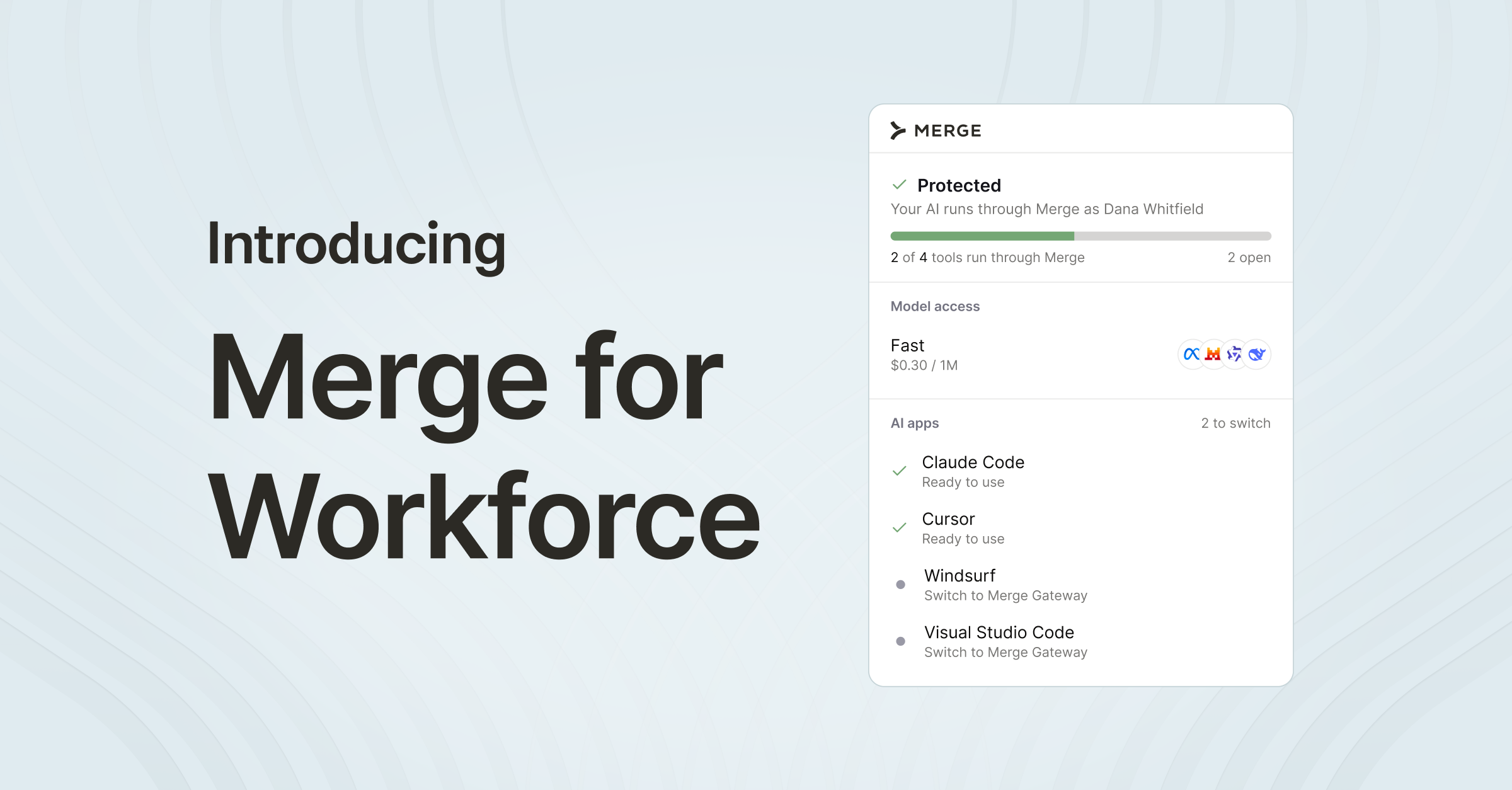
Yes, Merge for Workforce is built to help engineering organizations provision, secure, and govern how employees connect AI tools like Codex to payment systems like Stripe.
Common patterns include:
- Provisioning and access control via SCIM with identity providers like Okta and Microsoft Entra ID, so IT can manage which employees can reach which Stripe data and operations by role or team
- DLP and policy enforcement on tool calls, so admins can block Codex tasks from reading live card data or customer PII, or restrict them to a limited scope before results reach the agent
- User-level audit logging so security and IT teams can review which Stripe objects were read, which operations ran, and which data was accessed, by which employee identity, and when
Taken together, employees can use the Stripe MCP to scaffold billing features against real catalog data, generate webhook handlers that match live events, write integration code that reflects the account's real configuration, and more, while IT keeps centralized control over which Stripe data and operations each developer's agent can reach.
Jon Gitlin
.png)
.png)

Connect Codex to thousands of tools with Merge Agent Handler
Use Merge Agent Handler’s 150+ connectors (including Stripe) to power reliable, secure, and powerful agents.


But Merge isn’t just a Unified
API product. Merge is an integration platform to also manage customer integrations. gradient text
But Merge isn’t just a Unified
API product. Merge is an integration platform to also manage customer integrations. gradient text
But Merge isn’t just a Unified
API product. Merge is an integration platform to also manage customer integrations. gradient text
But Merge isn’t just a Unified
API product. Merge is an integration platform to also manage customer integrations. gradient text